Thursday, February 4, 2010
Call for applications :: PHD Art in Practice
Although a decade too late for me, I´m thinking about the virtual possiblities, emminent projects and evidenciary results that the HOUSING institution provides and how its heavy influence would affect the intrinsic qualities of art practice and its research. Can basic structures of why it is art practice research be established accross instutitions and mother disciplines?
Why the art of identity, the art of cooking, business, the art of, of, of....what encompasses the label "art"? Is it the concept, the process of construction, metaphor, or what Deluze´s "abstract machine."
Monday, January 4, 2010
The Art of Identity in a Postmodern America
There is an art to identity. In the article Hugo linked us to in the prior posting, Shelby Steele gets it wrong because Steele is trapped within the need promote a conservative ideology. Ideology locks us in small boxes. Within Steele's little box, Ronald Reagan is always the hero, the ever-meaningful icon of his right-wing political ideology. President Obama is interpreted, in contrast, as being "hampered by a distinct inner emptiness."
Other popular right-wing ideologues like Rush Limbaugh and Sean Hannity have flooded the talk radio airwaves with open frustration over the popularity of the newly-elected President of the United States, Barack Hussein Obama. The radio audience is repeatedly told that Obama is nothing but an empty suit, a symbol without any substance or fundamental values, and that the masses are enthralled with a cipher that we don’t really know anything about. I would argue that they are absolutely correct. Obama, in all of his identity travails—those internal to his separation from his father, those foist upon him by his current political detractors, and those resulting from the continuing navigation of those structural inequities of identity interpretation still strewn across the American landscape because of this nation’s forefathers inability to dismantle their homegrown racist inclinations—has been loosened from any fundamental moorings about the capability of Black men to become a floating signifier of identity. His signifying achievement is likewise the potential of all who travail, those who do not fit neatly the labels and the diminishments and the detractions, who wander the earth without certain identity.
Ultimately, Obama changes everything. All United States Presidents prior to Obama have signified a power structure that is derivatively Western and, thus, anti-Other. Obama, non-Western both in appearance and in his given name, has forever complicated the conversation about race and identity in America. Does Obama as POTUS and figurehead of the American experiment actually represent the American social drama we have known throughout history, an America that has been represented almost exclusively by non-Blacks in the media and public imagination? Of course he does, perhaps better than anyone else prior, whether everyone likes it or not. A cipher, yet to be fully told, can indeed represent a nation.
Of course, no identity is actually fixed; all identities tend to unhinge themselves over time. However, when a person becomes a floating signifier they also work to redefine the other identities in whose contexts they become enthralled. Within Obama’s proximal zone, the Democratic party and it liberal constituency have been redefined; the Republican party and its conservative constituency also finds itself redefined in their opposition to Obama’s success; Blacks have been redefined; people of mixed lineage have been redefined; marginalized people groups and their agency have been redefined; and the list goes on.
Steele is wrong. President Obama is not empty. Like me, like any other floating signifier, he is pregnant with possibility. He is full. There is an art to identity that makes all such symbols full. I discuss these matters and more in my new book, Cinderella Story: A Scholarly Sketchbook About Race, Identity, Barack Obama, the Human Spirit, and Other Stuff That Matters, which will be published by AltaMira Press in 2010. I consider it a work of arts-based research. I'll let you know when it's available.
Sunday, January 3, 2010
>The sophistication of seeing what isn't there rather than what is<
The president always knew that his greatest appeal was not as a leader but as a cultural symbol.
Saturday, December 26, 2009
New Website, Blog and Teaching Resources
Although this blog has only been in intermittent operation for just over a year, it has generated a good amount of conversation. I hope that all of you are willing to continue to the next phase, which promises to be much more active and have a lot more resources and support on hand. Because plenty of good discussion has already taken place on this blog I have documented this archive and migrated it to the new blog currently under development. This blog, artasresearch.blogspot.com will remain online for another month or so until the new site is fully operational.
We will be going public in a couple of weeks, and expect to be fully operational by the end of January. However, if you are interested in checking out the website material NOW, as it is currently being developed, then send me an email (artasresearch@gmail.com) and I’ll add you to the list and send you instructions.
Introducing New Edition
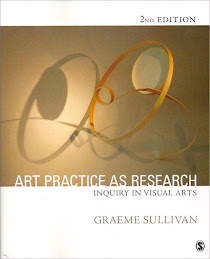
As I mentioned in a comment a long while ago, the big project for this year was completing a new edition of Art Practice as Research. This involved a major re-write and update as I considered the literature that has appeared since the first edition was published. I was also able to think more clearly about many of the original propositions and descriptions about art and research. To this end, the new version is more integrated in linking the arguments and includes more ideas and examples. A couple of new chapters are included. A new Chapter 3, Practice and Beyond, explores the landscape of Practice-Based Research and Practice-Led Research that is developing rapidly in the UK, Europe and Australasia. These developments are quite different to the moves being made in North America under the banner of arts-based educational research (which is discussed in Chapter 2: Paradigms Lost). An additional chapter was also included that describes some ways of thinking about exhibition-based research projects and these range from international context such as the 2007 Venice Biennale, to a small artist-run gallery in Brooklyn (Pearl Street Projects) as well as examples of a few dissertation research projects. Much has been re-worked and much more added to the new version, and this includes doubling the reference to participating artists represented in the book.
In new post I’ll give an update on other web resources currently being developed,
Hope the New Year is most rewarding for everyone.
Wednesday, December 9, 2009
an example of a blog generated in connection with a new book about arts-informed research in another discipline
Saturday, December 5, 2009
Looking for examples of arts-based research so concrete a social scientist can understand
I've begun a risky endeavor...introducing the arts-based research paradigm to a faculty of School of Education colleagues steeped in the social science paradigm. Here is a response from my Dean:
"James, I have been thinking quite a lot about your Wednesday luncheon talk and the questions that followed. I found myself struggling with trying to figure out what arts-based research is. Is it painting, photography, performance art that examines particular themes, for example the urban high school or global migration, through artistic projects? Do you have some examples of such what you and the field would call art-based research projects that I could look at? I ask for this only so that I can somewhat knowledgeably speak about your work."
What I would like to begin to outline for my School of Education colleagues is that the ABR paradigm is sorely mischaracterized and underestimated if it is reduced to a discussion of alternative forms in which to represent collected data, data analysis, or interpretation. I want to argue that, just like the social sciences, arts-based research yields lasting methodologies for doing research, methodologies which we can then name and revisit.
For instance, ethnography, a methodology for doing cultural and social anthropology, was developed, elaborated, and given a name as a method of investigation along with the rise of travel and anthropological literature in the nineteenth century; the first citation of the term is from 1834. It had a point of origin where only a few used it for research; today, ethnography is relied upon by many.
Likewise, an ABR methodology called a/r/tography has been developed, elaborated, and given a name over the recent years and is described by Dr. Rita Irwin as "means to inquire in the world through an ongoing process of art making in any artform and writing not separate or illustrative of each other but interconnected and woven through each other to create additional and/or enhanced meanings," emphasizing the interwoven identities of the artist, researcher, and teacher.
A colleague of mine, Dr. Lace Marie Brogden, a Canadian curriculum theorist with a poetic writing practice who experiments with narrative forms of inquiry, has recently articulated a methodology she has termed art/I/fact/ology, an autoethnographic approach to research that sifts through memory and material artifacts, blending notions of archaeology and bricolage and writing as research method.
And just in case you haven't guessed it by now, I'm also arguing that arts-based research is most effectively modeled upon a reflexive arts practice of some kind at its core. Otherwise, it's only arts-informed research--not a bad thing necessarily, but often indicating a researcher who has only begun to dabble the toes in the water and who has a far less developed grasp of the arts practices as a way of knowing and creating new knowledge.
So, to address the desire of a bunch of puzzled social scientists as to how the arts can be understood as a species of research, I am asking if you can help me generate two very specific lists:
First, a simple listing of emerging (or perhaps ancient) arts-based METHODOLOGIES, that have yielded notable research outcomes and which have stood or may stand the test of time, being revisited by OTHER researchers. Some of these methodologies may overlap the qualitative research paradigm and its social science underpinnings. That's okay. But I need help giving these methodologies a name.
Secondly, I would appreciate if you could share with me the specific references of any articles, exhibitions, and/or performances that you would cite as a significant exemplar of arts-based research. Of particular interest to me are exemplars of ABR that address larger educational or social research questions.
Thanks and please pardon any duplicate postings on other list-servs,
James
Tuesday, November 3, 2009
http://typographyiran.blogspot.com/
http://art-iran-blog.blogspot.com/
Leave comments!
Thursday, October 15, 2009
art education as a concept.
and gathering several ideas that we will move from a knowledge societey to a skill society, the follwing question came to mind:
Is art education a concept; and as as such will it ever jump from its ¨developemental stance" into what kind of body of knowledge that resides on skill?
Sunday, August 30, 2009
Take a look at some recent grad student work
Any feedback or suggestions would be much appreciated. I'll write more about the ups and downs of this approach and program after I have some time to digest what's happened.
Monday, August 10, 2009
Breaking the mold, on laptops and the NAAE
(For three years a submited lecture proposals with a 0 of 5 batting average. Only Dan sneak me in a group prsentation, I think I may have been forced out of the market, well just do art and reflecting on new perspectives and implementation of the art products that the academica and artworld bias happen in the trenches and may have missed)
the brief article
Tuesday, July 14, 2009
Three types of arts research candidates
This profiling struck me, as I had fallen into both #1 and #3 candidate profiles. My project required a standard written dissertation but I could not pull it off without creating my own visualization models, compiling a CD, and doing qualitative analysis via a non-linear video editing system. In addition, I showed my own work as it was influenced by being an artist-researcher; followed by an exhibition of the case study participants that I utilized. This seems now to have been a little much. I think the struggle Burgin sees with candidate #3 (which is perhpas the most interesting in terms of advanced studio arts research) is how to validate their practice. He also believes that #3 is the most common candidate for further study.
In an information age with complex data sets, new forms of representation emerge and the need for visualization models increases. Perhaps we could consider a new possibility for the dissertation being more visual than written e.g. documentation of an installation plan of an emerging art object, a series of visualization models with supporting theories cited, or an exhibition with catalog essay and theoretical framework displayed, etc. Tomorrow we may not write at all -- perchance we'll make only video for web distribtuion. We create in an audiovisual polysensate environment -- should not the studio arts proof out in a way that reflects this? Even if a compromise was struck to reduce the amount of written material or incorporate it into the visual components in a way that integrates text to work, instead of separating it.
I realize that doctorate study has history and research in other arenas and has required a book length text for completion, but why must we extend the hierarchy of text to image moving forward?
Tuesday, April 28, 2009
Could academic arts research help...
Monday, April 13, 2009
over in Scandinavia...
Reflections and Connections
On the relationship between creative production and academic research
Nimkulrat, Nithikul; O'Riley, Tim (eds.), 2009.
new book free download.
A couple of ideas I've been concern about "growing the baby" that resonate in the first entry title Throwing the Baby Out or Taking practice Seriously, ==Ilpo Koskinen== about the level of skill, in art and reserch, to immerse in art research, that finishes with>...the current state of artistic research needs serious rethinking in order not to become just another useless and fairly expensive experiment prompting cynicism about artistic research among its key audiences, artists and researchers alike. I feel that the romantic model for doing artistic research is deadlocked, and unless it changes its direction, very little will remain in then years." ...as it is my perception on some current paradigms of art ed.
But where, maybe rethinking in Edwin Abbot's Flatland, 1884, (the first little chapter, I'll dig it out later) to evaluate the dimensions of the art research dynamic viewed from artistic practice and not the academic structures.
Another observation on the file formatting is how the pdf has a strong graphic element, blue, to immediately locate the different essays.
Sunday, March 29, 2009
Artists with PhDs - New book by James Elkins
Artists with PhDs - James Elkins
The studio-art PhD, or practice-based doctorate, is a hot topic in art instruction in the US. Other countries have had these degrees for several decades; in the UK there are up to 2,000 students currently enrolled in such programs, and there will soon be 10 universities in Australia that offer the degree. At the moment there are about 10 programs in the US and Canada, and another dozen more under development. It appears that the PhD in studio art will become the next MFA--that is, the expected terminal degree for artists who want to get jobs teaching. In twenty or thirty years' time, it is likely that every major art school and department will offer the PhD. The degree is controversial wherever it exists, and there is a fair amount of resistance to it: there have been some stormy sessions on the subject at conferences. Most of the formative issues, from grading to accreditation, remain unresolved.
This book is the first of its kind in the US. It is meant as a resource to help artists, teachers, administrators, and students assess and compare the new programs. Part I is a selection of essays by the best-informed people on both sides of the Atlantic, including most of the principal players and institutions. Part II is a selection of excerpts of the PhD dissertations written by people who have graduated from such programs, so people can see the kind of art and scholarship the programs produce.
Here are the contents of Part I:
1: Judith Mottram, 'Researching Research in Art and Design'
2: Timothy Emlyn Jones, 'Research Degrees in Art and Design'
3: Henk Slager, 'Art and Method'
4: Mick Wilson, 'Four Theses Attempting to Revise the Terms of a Debate'
5: Victor Burgin, 'Thoughts on 'Research' Degrees in Visual Arts Departments'
6: Timothy Emlyn Jones, 'The Studio Art Doctorate in America'
7: George Smith, 'The Non-Studio PhD for Visual Artists'
8: Hilde Van Gelder and Jan Baetens, 'The Future of the Doctorate in the Arts'
9: James Elkins, 'On Beyond Research and New Knowledge'
10: Charles Harrison, 'When Management Speaks...'
11: James Elkins, ''The Three Configurations of Studio-Art PhDs'
Most of the literature justifying and defining these programs was written in the UK, although the programs can now be found around the world. This book has a double purpose: the selection of authors and artists is intended to span a wide range, showing how the PhD is implemented in different places; my own contributions are meant as polemics, because I am unconvinced by the rhetoric of 'research' and 'new knowledge' that continue to frame discussions on the subject. It seems to me there is an opportunity to reconfigure discussion in the US, and to remake these programs in a new mold.
New Academia Publishing is a peer-reviewed, print-on-demand initiative; the books may not show up in bookstores, but they are always quickly available through Amazon and other outlets.
Friday, March 6, 2009
teaching and believing in what, and how, is taught
First Bill Gates comments on "how to make a teacher great", in a TED talk (around minute eight) and his research on the null or minimal effect of EdM to better teaching practices.
And secondly, along personal reflection on the link between the current financial crisis and the education of those who are supposedly in control of things, I found Kevin Hasset's article:"Harvard narcissists with MBAs killed Wall Street" that in my view ponders upon higher education replicating institutional models and making believers out of most students.
Thursday, January 1, 2009
Revised Edition of Art Practice as Research in Preparation
I'm pleased to be able to report that a revised edition of Art Practice as Research is currently underway. The publisher is planning for a release by the end of 2009. The revision will entail a re-write of some of the main chapter sections and arguments and an additional chapter of studio-based research projects. A goal is to clarify how the theoretical views presented in Art Practice as Research can be further defined to extend the widespread development of studio art research practices underway. Several anthologies have been published in recent years, especially in Europe, US and Australasia, and these are helping chart some of the exciting changes in the field. However it is important to ensure that the arguments used to theorize art practice as research continue to be well grounded.
As I go about the re-write, I'd be very interested to hear from anyone who would like to offer critical comments on any aspect of the first edition of Art Practice as Research, or any other suggestions. Comments can either be uploaded to the blog, or if a less public form is preferred the email attached to the blog can be used: artasresearch@gmail.com.
In the spirit of this blog where a goal is to build to community of studio research practitioners, the re-write of Art Practice as Research will be accompanied by the development of a more comprehensive web-based support structure where additional information and resources will be available. I look forward to these new conversations.
Friday, September 19, 2008
The artist in academia and the shape of things
There are two more videos that preceed this one, they show the evolution of the visual thinking idea and how the role of the characters change. For me they raise several points of consideration that I will comment later on.
Enjoy, think, and reflect!
I came accross this material through an Amazon recomendation of the book that ended in "The back of the napking" blog (http://digitalroam.typepad.com/digital_roam/) where the Visual thinking #2 video was presented.
Thursday, September 11, 2008
A thought...
I wanted to share with you a project I am currently working on. I think it's concept and purpose is relevant to the discussion on/around your book. Myself and a friend, Anne Laure Fayard whose doctorate/education is in both cognitive sciences and philosophy, are working on an installation, ' Building Space With Words' scheduled for March 2009, which both shares her research in technology mediated communication and collects further data so to speak. It is an interactive blog that will be projected onto a maze-like space in the gallery. Various academics, architects and artists will be invited to reflect on what the issue of 'space' means to them in their various fields in a blog, which would then be used itself to create the space in a sense. Interestingly to me, we find ourselves discussing art practises along side the research practises of her field. She finds herself at the edge of her field, more comfortable working with artists, borrowing their practices and language to share her work. I just stumbled on this quote the other day:
'Given that we are paid to do research, what is there to monitor the research we are doing? How can we keep informed people who might be interested in it, or who might have some reason for taking this research as a starting point? How can we keep them informed on a fairly regular basis about the work we are doing, except by teaching, or in other words by making a public statement.
Foucault, F. “Society Must Be Defended”: Lectures at the Collège De France, 1975-1976, edited by Mauro Bertani and Alessandro Fontana, translated by David Macey, (New York: Picador, 2003), p. 1.
Best,
Aileen